Top 10 Localization Platforms for Effortless Global Business Expansion?
In today’s fast-paced global market, choosing the right localization platform is vital for businesses aiming for expansion. A recent report by Nimdzi Insights indicates that the language services market is expected to grow to over $56 billion by 2027. This growth underscores the demand for effective localization solutions. Companies that leverage localization platforms can tailor their content, enhancing customer experiences across diverse cultures.
The right localization platform allows businesses to communicate more effectively. For instance, 75% of consumers prefer purchasing in their native language, highlighting the importance of localized content. Yet, many companies still struggle to implement comprehensive localization strategies. Challenges like inconsistent quality and scaling difficulties can hinder progress.
As businesses navigate the complexities of international markets, reflecting on the strengths and weaknesses of various localization platforms becomes essential. Understanding the specific needs of different regions allows for better alignment with local customs. Choosing a platform that balances efficiency and cultural understanding can make or break global strategies.

Understanding Localization and Its Importance in Global Business
Localization is crucial for businesses aiming for global reach. It's not just about translation. It involves adapting content to fit cultural norms, idioms, and preferences. For instance, the color red may symbolize luck in one country, while it represents danger in another. Understanding these nuances enhances customer connections and fosters loyalty.
However, many businesses overlook these subtleties. They might use generic translations that miss the mark. This can lead to misunderstandings and alienate potential customers. Effective localization requires more than just language changes. It demands attention to context—what resonates with local audiences?
Additionally, technology can assist in this process but it is not foolproof. Automated tools often miss cultural references or tonal subtleties. While they speed up workflow, human expertise is irreplaceable. A balance between tech and human insight is vital. As companies expand, reflecting on their localization strategies can ensure they engage authentically with diverse markets.
Key Features to Look for in a Localization Platform
When expanding globally, choosing the right localization platform is essential. A study from Common Sense Advisory revealed that 75% of consumers prefer products in their native language. Therefore, finding a platform that effectively handles translation and cultural nuances is vital.
Key features to look for include user-friendly interfaces. Many platforms boast advanced AI, but simplicity matters. Teams can struggle if the design is overly complex. Another crucial aspect is integration capabilities. A platform should seamlessly connect with existing content management systems and workflow tools. This ensures smooth operations and faster turnaround times.
A reliable localization platform must offer comprehensive analytics. Understanding how translations perform can guide future strategies. Yet, many businesses overlook this detail. They miss valuable insights that can enhance localization efforts. Additionally, consider collaborative features for internal teams. Real-time editing and feedback can significantly boost project accuracy and speed. Balancing technology with human touch remains a challenge.
Top 10 Localization Platforms Comparison
Top Localization Platforms: A Comparative Overview
In today's global marketplace, localization is crucial for successful business expansion. Companies that adapt their content for different cultures can boost their revenue significantly. According to a report from Common Sense Advisory, 72.1% of consumers prefer to buy products in their native language. This statistic underlines the importance of using effective localization platforms.
Choosing the right localization platform can be challenging. Many options exist, each with unique features and pricing models. For instance, some platforms support a wide range of languages, while others may excel in customization. Businesses should consider their specific needs carefully. A study by Nimdzi Insights revealed that 28% of companies struggle with finding suitable localization tools. This indicates a market gap that requires attention.
Tips: Focus on user-friendliness. An intuitive interface saves time and enhances productivity. Always opt for platforms with robust support and analytics features. Data-driven decisions can lead to better outcomes. Take your time to assess available options. Don’t rush the process; the wrong choice can hinder expansion efforts. Balancing features, cost, and usability is key for sustainable growth.
Top 10 Localization Platforms for Effortless Global Business Expansion
| Platform |
Key Features |
Supported Languages |
Pricing Model |
User Rating |
| Platform A |
Automated workflows, In-context editing |
50+ |
Subscription |
4.8/5 |
| Platform B |
Collaboration features, Glossary management |
40+ |
Pay-as-you-go |
4.5/5 |
| Platform C |
API integration, Machine translation |
60+ |
Freemium |
4.6/5 |
| Platform D |
User-friendly interface, Quality assurance |
30+ |
Tiered pricing |
4.3/5 |
| Platform E |
Project management tools, Reporting |
25+ |
Monthly subscription |
4.7/5 |
| Platform F |
Custom workflows, Scalability |
35+ |
Custom pricing |
4.4/5 |
| Platform G |
Round-the-clock support, Localization memory |
45+ |
Annual subscription |
4.9/5 |
| Platform H |
Integrated marketing tools, Analytics |
55+ |
Per word pricing |
4.2/5 |
| Platform I |
Content management, Contextual feedback |
20+ |
Flat rate |
4.1/5 |
| Platform J |
E-commerce integration, API support |
65+ |
Usage-based |
4.3/5 |
Evaluating Costs and ROI of Localization Services
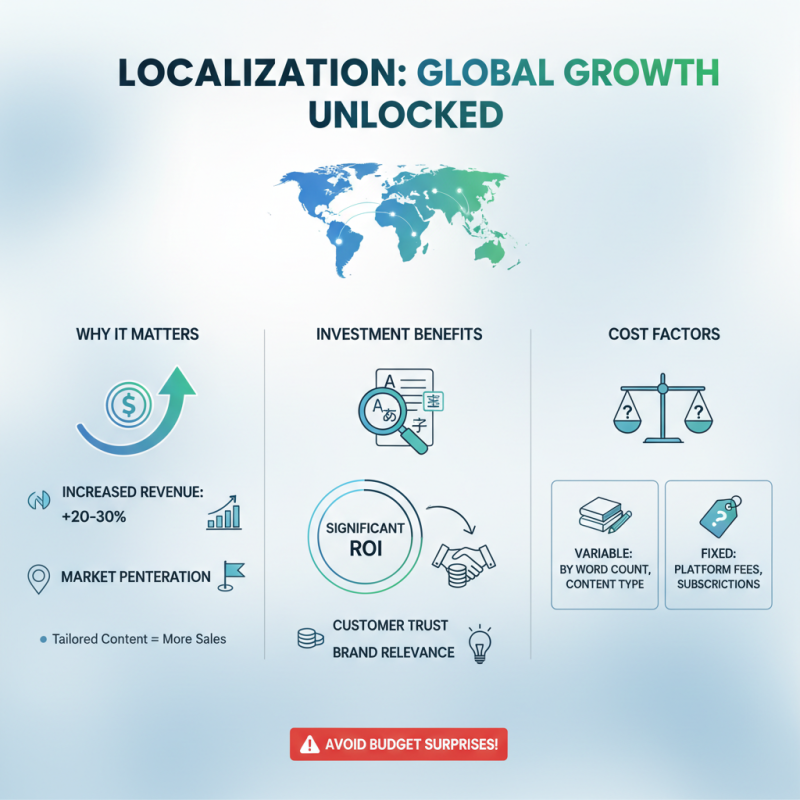
Localization is crucial for global expansion. Companies that invest in localization often see significant returns. Reports indicate that businesses can increase revenues by 20-30% when they tailor content for local markets. However, the costs of localization can vary widely. Some platforms charge by word count, while others have flat fees. This can lead to budget surprises.
ROI in localization is complex. Not all projects yield immediate results. For instance, a study showed that 65% of businesses reported long-term benefits from localized content. Yet, many struggle to track the impact of localization on sales. Optimizing the process can help. Detailed metrics are essential for understanding the effectiveness of these services.
Many organizations underestimate the challenges of localization. It isn't just about translation; cultural nuances play a role. Companies often overlook these aspects, resulting in poor reception. Crafting relevant content takes time and resources. It requires careful planning to avoid pitfalls and ensure success in diverse markets.
Best Practices for Implementing a Localization Strategy
Implementing a successful localization strategy is crucial for global business expansion. Research shows that 75% of consumers prefer to buy products in their native language. This highlights the importance of understanding local markets. Localization goes beyond mere translation. It involves adapting content to resonate culturally with the target audience. Companies must be aware of cultural nuances, symbols, and references that may not translate directly.
Effective localization requires collaboration across teams. Marketing, product development, and legal teams must work together. Miscommunication can lead to costly mistakes. For example, using images or phrases that are culturally sensitive may offend potential customers. In a recent survey, 45% of respondents reported that cultural missteps negatively impacted their perception of a brand. Regular feedback from local teams can help mitigate these risks.
Investing in the right tools also plays a vital role. A robust localization platform can streamline processes. However, 60% of businesses still struggle with integrating these tools effectively. Poor integration leads to inefficiencies and wasted resources. Localization efforts should be continuous. Adapting content over time is essential to keep up with changing markets and consumer preferences. The journey of localization is a complex one, filled with both challenges and opportunities for growth.


.avif)





.png)


